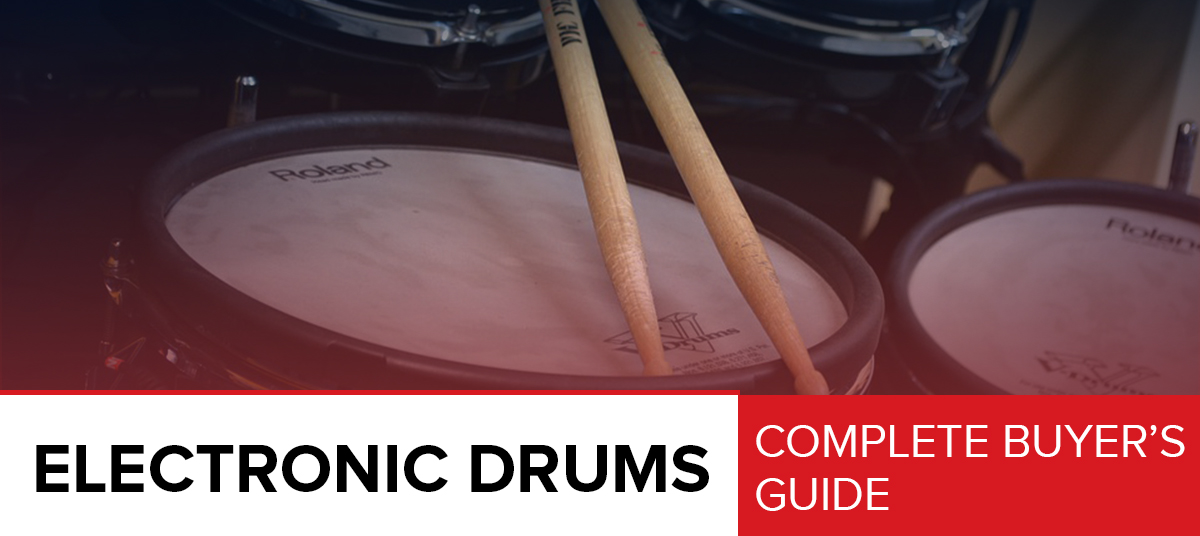
Electronic drum sets are becoming more and more popular for a number of reasons, one of the larger being the fact that this technology is steadily dropping in price. Because of that, we've decided to treat you with a list of our picks for the top 10 best electronic drum kits on the market.
Once we go over our picks, we'll get into what makes electronic drum kits so interesting and how even the most traditional drummers can benefit from owning one of these instruments. By the time we're done you should have all the necessary information about electronic drums.
Top 10 Best Electronic Drum Kits
Category Breakdown
Electronic Drum Sets For Beginners
Much like it is the case with other musical instruments, models designed for beginners are going to be pretty limited in terms of features, hardware and software. With that said, every model of this type should meet a certain criteria. We have chosen a number of models which do.
Each of the picks in this category will offer you a very consistent and reliable tool you can use to learn how to play drums. Some of the models are even quite advanced by all standards. This is also the budget segment of the market where you will find your cheapest rigs that actually work.
Electronic Drum Sets Under 500
The next step up are kits that cost up to $500. The beginner segment and this segment tend to interested quite a bit. One thing to keep in mind is that models right around that $500 mark will be a great deal better than anything that's $100 cheaper.
This segment of the market is a good starting point for anyone who wants something better than the basic entry level model, but isn't willing to commit to a more expensive rig.
If you take your time and do your research, you can find some pretty awesome models in this category, just like we did.
Electronic Drum Sets Under $1000
Upping your budget to $1000 opens a whole world of new opportunities. Models from thus price range aren't exactly flagship offerings of their respective brands, but they absolutely offer a great bang for the buck when it comes to features, hardware and software.
To put it simply, the difference between the $500 and $1000 is much more drastic that the difference between a $1000 and a top tier model. Once you go over that magical price mark you will start seeing diminishing returns on your investment which is why we chose it as a our upper cap.
This segment is where all your advanced sound models are with the newest engines and extensive sample libraries.
Electronic Drum Pads
The last category of electronic drum kits are electronic drum pads. These are different from everything we have covered so far and come in two distinct formats.
You have a grid pattern pad designed to complete and make your acoustic or electronic drum set that much more flexible. The other option are the portable drum kits which were meant to give you a platform to practice on with ease. Keep in mind that these are not necessarily going to replace a full sized electronic kit, but definitely have their own place in the grand scheme of things.
As a rule of thumb, the former type of electronic pads can be quite expensive while the latter is usually affordable.
Origins Of Electronic Drum Kits
Electronic drum kits come as a culmination of one man's passion for percussion instruments which was influenced by the current technological advancements of the time. It all started with Felix Visser and his dream of designing a machine that would do the rhythm section on its own.
Being a sound engineer himself, it didn't take him long to design such a machine. Ti was called Ace Tone and it actually worked. Visser quickly got noticed by Ikutaro Kakehashi and together they've started working towards the first actual electronic drum kit that sported reactive pads and a layout similar to the acoustic sets.
Interestingly enough, Kakeshashi later went on to crate Roland which is still one of the main innovators in this industry.
Needless to say the evolution of drum kits was slow, painful and often times set back by a variety of different issues. The main problem was that no matter how good a kit Roland or other brands would build, it would immediately be compared to a top tier acoustic set and quickly deemed inferior. We are just getting to a point where that line between acoustic and electronic is getting blurred.
How Do Electronic Drums Work?
The whole idea behind electronic drums is to have reactive pads which trigger a sound sample when you hit them. That is a very simplified explanation. In reality, the pads are sensitive to velocity, angle of attack and several other factors, all of which will influence what kind of sound you get coming from the speakers.
The basic idea stands. Instead of relying on acoustic resonance, electronic drum kits use triggers located in the pads to 'create' or better yet, trigger a sound.
Main Components Of An Electronic Drum Kit
No matter what electronic drum kit you look at aside from those electronic drum pads, you will notice three main and several secondary components. These are universal and generally don't change regardless of which brand makes the kit.
You have the rack as the basis for the entire package. Next come the pads and cymbals and lastly we have the sound control module. Lets discuss each in detail.
Here is a very good recap video by 65 Drums (Great YT channel that we recommend for some awesome drum tips and guides):
Racks
Racks are extremely important. Just like hardware on acoustic drum kits, you want your pads and module sitting on something that is reliable and consistent. Sings of a good rack are easy to spot. It will be made of durable materials, usually thick tubing of some sort.
It will be robust enough to easily carry the weight of the kit, but most importantly, it will allow you to customize the kit to fit your body. We can't emphasize this factor enough. If you can't find that comfortable position, your technique will suffer and so will your eagerness to sit down and play. A good rack is a necessary foundation of every electronic drum kit.
Pads and Cymbals
This is where things get a bit complicated. We have given you a very crude explanation of how pads work. You hit them with a stick and they produce a sound. In reality, they are much more complex than that. For starters you have dual and triple zone pads.
There are ones with more zones than that but those are fairly rare. Same goes for cymbals. Depending on your choice of drums and how much money you are willing to invest, you can expect to find some pretty simple pads but also some which will allow you to use the full extent of your skills as well as technique.
Actual performance is just one side of the story, though. The other is the feedback you get on the stick. Every drummer knows what a snare drum or a top feel like on the drum stick. There are slight variations between different heads but they generally feel the same. Emulating that kind of stick feedback on an electronic kit has been the holy grail of this whole industry for a while.
Well one of the holy grails at least. There are different types of pads and cymbals out there. Most common are the standard rubber pads, but we are seeing a surge of mesh pads and other solution which greatly improve the overall feel and sensation playing an electronic kit.
Sound Modules
Sound modules and sound engines are an extremely interesting part of this whole story. Not only are we looking at hardware which needs to be lightning fast in order to nail the necessary timing, but it also needs to process the user input and trigger a high quality sample.
Sound modules are exactly what you would expect them to be. They are computers which are loaded with all kinds of software and sample libraries. Every module comes with hands on controls which will allow you to navigate the available features, select different presets and so on. More modern modules come with a bunch of apps which allow you to do all of this over your smart phone.
Libraries are just one part of their purpose. The other is to house a sound engine capable of negotiating the input and selecting the right output. As you go up in price range, you will start running into some pretty expensive rigs. One of the reasons why they are so expensive is because their modules are packed with sound engines which run almost latency free and offer impressive sound quality.
Paired with quality recordings of acoustic drum sets, you are looking at rigs that sound exactly like their acoustic counterparts. However, that type of performance is mainly reserved for flagship models. The more affordable ones won't be as authentic but they won't sound fake either. It all comes down to finding something that you like in terms of sound quality and samples.
How To Pick The Right Kit For You?
There are pretty much two main questions you have to answer, which will point you in the right direction. It all comes down to your intended purpose for that kit and how much money you are willing to spend on it. It is as simple as that.
Budget
Defining the budget for any musical instrument is painful work. There's always that one model that is just slightly out of reach. The best advice we can give you is to get the best kit your money can buy.
If that means a semi pro $1000 rig, so be it. But if it means a $300 beginner model, that is perfectly fine too. As long as you are aware of your budgetary limitations and are realistic, you will have great models to choose from.
Intended Purpose
The other important question is what you intend to do with your kit? Is it going to serve as a practice rig at home? Are you going to use it for gigs too? Or is it going to be a something you will carry with you to practice because your acoustic kit is too bulky for that kind of moving around?
Answering this question is pretty important because there are sets out there that cater to all of these requirements and then some. If you need a portable, compact set, chances are that you will go with something with a very limited footprint and a light rack.
On the other hand, if you need a kit that is good for gigs, you will have to get one that has a pretty decent module and a good library of samples. Find an answer to this question and you will be half way done.
Stick With Big Name Brands
Electronic drum sets are one area where sticking with big name brands is literally the best way to go. The reason for this is that there aren't many of them competing for the market share and they are all constantly working on establishing that new standard and rolling out that new piece of technology.
Sure, there are some lesser known brands out there who make great gear, but you will definitely want to stick with say Roland or Yamaha if you need a high end workhorse kit.
Conclusion
Electronic drum kits may not be at the point where they'll replace acoustic sets, but they are definitely getting there. Model we have shown you on this list represent a very decent cross section of the current market and offer a great set of choices for those who are looking to get into electronic drums.
We did our best to select the very finest models from all relevant segments of the market in an effort to ensure that everyone can find a good deal according to their means. All you really have to do is pick the one you like.