Buying guide
The Must-Have Guitar Accessories
Let’s set the scene. Like many complete beginners, you have just purchased a new electric guitar and an amplifier, with nothing else… Now what?
8models covered
11ways to narrow it down
Narrow it down
Every guitar accessories we cover
| # | Model | Brand | What we said |
|---|---|---|---|
| 1 | Line 6 Relay G50 | Line 6 | Clear, loud and proud. |
| 2 | AKG WMS 40 Mini | AKG | Highly versatile package with a top-notch price tag. |
| 3 | Joyo JW-01 | Joyo | Lowest priced item on the entire list here, yet it still offers a solid performance. |
| — | Line 6 Relay G30 | Line 6 | This fella has everything the G50 has. |
| — | Shure GLXD16 | Shure | This item showcases the company’s domination in terms of sonic excellence. |
| — | Shure PGXD14 | Shure | This is Shure we’re looking at, so needless to say, sonic quality is spectacular. |
| — | Audio Technica System 8 ATW-801/G-T8 | Advanced dipole antenna that grants it a surprisingly wide operating range. | |
| — | Nady U-1100 GT | Offers quality that’s worth at least 20% more than the listed price tag. |
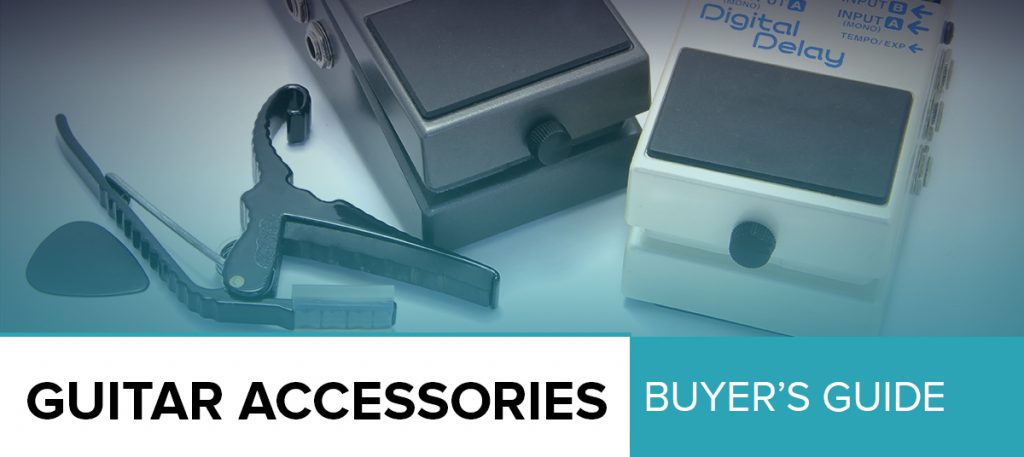 Let’s set the scene. Like many complete beginners, you have just purchased a new electric guitar and an amplifier, with nothing else… Now what?
Some electric guitars come as part of a guitar starter pack, which bundle together a lot of different accessories to provide great convenience and value. However, some of the accessories that come with these kits are a little… well, they suck. That’s not to say that they aren’t useful for their intended purpose, just that they are usually best used as a stopgap while you accrue some upgrades.
In this article we are going to highlight the must-have guitar accessories you need to buy to get the most out of your guitar – whether an electric, acoustic, bass or classical. Some of them you will need from the moment you buy your guitar, others you can acquire over time. But all of them are important considerations if you are serious about becoming an advanced guitarist.
Note that we aren’t looking at amplifiers, strings or effects pedals in this article. While these are obviously important, they aren’t really considered an accessory – amplifiers and strings are fundamental to guitar, while pedals are in a completely separate category. However you can check out our buying guide for guitar amplifiers, our guide to guitar strings and our guide to guitar pedals for more on these crucial items.
With this in mind, let’s get started on our list of must-have guitar accessories!
Let’s set the scene. Like many complete beginners, you have just purchased a new electric guitar and an amplifier, with nothing else… Now what?
Some electric guitars come as part of a guitar starter pack, which bundle together a lot of different accessories to provide great convenience and value. However, some of the accessories that come with these kits are a little… well, they suck. That’s not to say that they aren’t useful for their intended purpose, just that they are usually best used as a stopgap while you accrue some upgrades.
In this article we are going to highlight the must-have guitar accessories you need to buy to get the most out of your guitar – whether an electric, acoustic, bass or classical. Some of them you will need from the moment you buy your guitar, others you can acquire over time. But all of them are important considerations if you are serious about becoming an advanced guitarist.
Note that we aren’t looking at amplifiers, strings or effects pedals in this article. While these are obviously important, they aren’t really considered an accessory – amplifiers and strings are fundamental to guitar, while pedals are in a completely separate category. However you can check out our buying guide for guitar amplifiers, our guide to guitar strings and our guide to guitar pedals for more on these crucial items.
With this in mind, let’s get started on our list of must-have guitar accessories!
Cable
We begin with quite possibly the most essential accessory for any electric or bass guitarist who wants to plug into an amplifier – a cable. Unless you are planning to play an acoustic or classical guitar with no amplification, then you’ll need a guitar cable to connect the guitar with the amp, otherwise you’ll have no way to hear yourself! An electric guitar will rarely come with its own cable, unless you are buying a bundle. Even then, the cables that tend to come with these bundles can be a bit flimsy and unreliable, so even if you already have one, you may want to consider upgrading soon. You’d be surprised at how much a decent cable can improve your tone. Buying a separate cable is usually a way to guarantee you end up with something more durable, which in turn means it is likely to be more reliable. We have a full buyer’s guide on what to look out for in a cable, as well as some recommendations in our article on the best guitar cables.Strap
Next on our list is a guitar strap – another essential you should have from the first day you purchase your guitar. This one is particularly relevant for acoustic, electric and bass guitarists (classical guitarists traditionally don’t use a strap, although some have been known to). Straps are essential for playing while standing up (honestly – try standing without one…), while they also provide more comfort and security while you sit and play. If you purchased a guitar starter pack, you may have noticed that the strap isn’t up to much. These are usually acceptable to start with, but they are often cheap, thin and feature synthetic ends, which can be prone to splitting – if you’re standing up when this happens, prepare yourself to hear your beloved guitar crash to the floor! You will be surprised at world of straps out there, all varying in material, length, design, width and price. If you’re looking for a strap, be sure to check out our complete guide and recommendations to the best guitar straps on the market.Tuner
Unless your guitar has the ability to automatically tune itself (this technology does exist by the way and is becoming more popular), you will need a tuning device. Sure, you can tune a guitar ‘by ear’ or ‘to itself’, but to ensure you are in tune with the rest of the world, a tuner is essential. Some people use a piano or a basic pitch pipe (often found supplied in a budget bundle), although the best method of tuning is to use a digital tuner. These battery-powered devices detect and display the note you are playing, and will tell you whether that note is sharp or flat, allowing you to tune up or down to the right pitch. These digital devices – which come as handheld, clip-on or pedals – are very accurate and surprisingly cheap. You can read more on finding the right tuner for you and our recommendations in the complete guide to the best guitar tuners.Case
Next up is something in which to store your new pride and joy – a case! As well as proving a great way to keep your guitar protected and dust-free when not in use, a good case or gig bag is also essential when transporting your guitar. You may just be taking it to school, a rehearsal or a local gig, or you may need something more substantial for carting your guitar on an around the world tour! If you have a case that arrived with your guitar as part of a bundle, chances are it is very thin, with no padding and a bit flimsy. This is quite standard and why most people upgrade a case almost instantly. When doing so, there are several considerations you should make – the first being whether it is for an acoustic or electric guitar, as they are very different sizes. You will also want to consider whether to go for a soft or hardshell case, the materials, the shape of your guitar (a Flying V usually requires a particular kind of case compared to a standard Superstrat!), how much to spend and whether you need additional storage pockets for other accessories. Our complete guide to guitar cases has more on all kinds of cases and gig bags, as well as some product recommendations.Stand
You have just finished your practice session. Now, where are you leaving your guitar? Of course, you could just prop it up against the wall or rest it on the floor and hope nobody accidentally kicks it over or steps on it. Or – like most sensible guitarists – you could invest in a good guitar stand. You don’t need to spend much to end up with a decent stand, as many A-Frame stands come in at around ten bucks, offering you an affordable way to secure and present your guitar when not in use. You can also find a stand to suit your specific location. If you are a guitarist with five guitars and plenty of room, a multi-rack stand is an awesome way to show off your beauties. Live in a one-bedroom apartment? A space-saving wall-stand may be more to your liking. We have outlined the different kinds of stands and other considerations, as well as some recommendations, in our complete guide to guitar stands – be sure to check it out!Capo
Unlike stands, straps and cables, a capo is not an essential purchase for all guitarists – in fact, some will never use one. However, for other guitarists, it is one of the most useful devices they can own. While they come in handful of different varieties, a capo is ultimately a small bar-like device that sits across the strings of your guitar, shortening the playable length of the instrument and changing the instrument’s open pitch. While you can technically use them on an electric guitar, they are mainly found in the toolkits of acoustic and classical guitarists, allowing them to completely change the sound of their playing – you would be surprised at how many of your favorite songs use a capo. Whether clamp, adjustable screw or yoke-style capo, we have several recommendations and a detailed buyer’s guide in our dedicated article on the best guitar capos.Slide
A slide sits in a similar category to a capo, in that it isn’t a must-have accessory for every guitarist, yet those who need one usually can’t live without one. Also known as a bottleneck, a slide is simple tubular device that slips over one of your fretting fingers (usually third or fourth) and allows you to slide between notes as well as create glissandos (think Hawaiian guitar). Sides are very often used in blues and country styles of music, and are associated with lap steel guitars in particular, although they are also often used on electric and acoustic guitars too. Slides are usually made of metal or glass, although you will also find bone, ceramic and porcelain slides. There’s more on slides as well as some recommendations in our complete guide to guitar slides.Humidifier
Unless you live in the Sahara Desert, electric guitarists can probably skip over this section. However, anybody with a solid or part-solid wood acoustic or classical guitar who lives in dry conditions will want to pay close attention. This is because slight changes to humidity can play havoc with wood, drastically changing the tone of your guitar as well as potentially causing permanent damage. Humidifiers are simple devices that remedy this. They sit inside a guitar or guitar case to regulate the humidity in and around your guitar, ensuring optimum storage conditions. You can also use a room humidifier to keep one room (such as a practice area or studio) at a constantly perfect condition for your guitars. You can read everything about humidifiers, as well as some recommendations, on our complete guide to guitar humidifiers.Metronome
A metronome is a training device that produces a sound (often a bleep or a click) at regular intervals, offering you an accurate and consistent way to measure your tempo when playing guitar. This allows you to improve your timing and gradually increase your speed. Metronomes will allow you to adjust the speed from ultra-slow to ridiculously fast, while most will also offer the ability to change time signatures and other variables. You can buy both traditional mechanical metronomes as well as digital metronomes, which both do the same thing, albeit with different advantages. One thing to consider is that some digital tuners already feature a built-in metronome. If you have one of these tuners, double-check it doesn’t already have a metronome feature before spending money on a separate one. As with the other accessories on this page, we have a dedicated guide to metronomes that is well worth checking out.Strap Lock
Earlier on this page we stressed the importance of a strap for your guitar – well, a strap lock’s job is to make that strap feel even more secure! These simple devices slip over the ends of your strap to firmly lock it in place, stopping the strap from accidentally slipping off the guitar (not something you want to happen when playing energetically on stage). They are usually cheap devices, although – as with the other must-have accessories on this page – there is no one-size-fits all strap lock, as they vary in price, design, function and materials. You can also find guitar straps with locking ends already built in, for extra convenience. You can read more about these devices, as well as some of our recommendations, in our complete guide to strap locks.Wireless System
This may not be a must-have accessory (especially for beginners and intermediate players), but while a cable is an essential tool for any electric guitarist or bassist, the next step is a wireless system. As the name suggests, these advanced systems allow you to connect your guitar, effects pedals and amplifier through wireless technology. The benefit here should be obvious – no cables means no restrictions on stage. These sophisticated systems aren’t there to improve your tone (although they do help it come across clearer) – they are simply there to give you a wire-free way of playing when on stage. Of course, you can read more about wireless systems, the considerations, and some of our recommended picks in our full guide to wireless systems. …and finally,Plectrums
Classical guitarists, as well as some bass and acoustic players, will have no desire to play with a plectrum (also known as a pick). However, for certain styles of music – and pretty much all electric guitar playing – a plectrum is a must-have accessory. Despite their simplicity, plectrum choice can actually be quite complicated with so many shapes, sizes, gauges and materials to choose from. The pick that’s best for you will be down to trial and error. As plectrums are so cheap, our advice is to go into any guitar store and pick up a handful – metal, synthetic and wood picks, in a couple of different gauges – then try them out with your guitar at home. You’ll soon find the pick that delivers the attack, tone and feel that suits your playing.What Accessories Do You Need?
Now you’ve seen the list of accessories we deem essential, you may be wondering how critical they actually are. We deliberately put the above list into a rough order of importance. Now, we can’t tell you that a cable is more important than a tuner, or a case is more useful than a stand, because the truth is that you’ll need to buy most of the accessories on this list if you want the most from your guitar. For example, it’s pointless having a great tuner only for your well-tuned guitar to fall over and break because it wasn’t in a good stand… and having a really nice capo won’t be much good if your guitar is damaged because you live in Nevada and you didn’t buy a humidifier! To help, if you are just starting out and have an electric guitar and an amp, we suggest buying a minimum of:- A strap
- A cable
- A stand
- A case
- A tuner
- Plectrums