Buying guide
Best Studio Monitors - Your Detailed Buyer's Guide
These inclusions comprised three higher-end models in the Neumann KH 120 A, the PreSonus Sceptre S8 and the Yamaha HS8.
36models covered
4brands with a page
6ways to narrow it down
Narrow it down
Choose by brand
Every studio monitors we cover
| # | Model | Brand | What we said |
|---|---|---|---|
| 1 | Neumann KH 120 A | Neumann | One of the clearest, flattest and most accurate monitors on the market. |
| 2 | PreSonus Sceptre S8 | PreSonus | Sensational sound from this unique coaxial speaker. |
| 3 | Yamaha HS8S | Yamaha | Typical HS Series build and performance for a quality listening experience. |
| 4 | Adam Audio A5X | Adam Audio | Lightning quick hybrid ribbon tweeter paired with top-tier hardware and smart design. |
| 5 | KRK RP8G3-NA | KRK | Great hardware combined with smart waveguide design and powerful set of amps. |
| 6 | PreSonus Eris E3.5 | PreSonus | For the price, this stylish speaker set is hard to fault! |
| 7 | ADAM Audio F5 | ADAM Audio | A truly impressive monitor with advanced tweeter design and a wide range. |
| 8 | IK Multimedia iLoud | Excellent sound for critical listening on the go. | |
| 9 | PreSonus Eris E4.5 | PreSonus | Pretty awesome balance of performance and power at a very reasonable price. |
| 10 | Tascam VL-S3 | Tascam | The underdog which has proven to be quite competitive with great hardware. |
| — | Adam Audio Sub8 | Adam Audio | A smaller but incredibly efficient sub from a very highly respected brand. |
| — | Alesis M1 | Alesis | Pretty compact set of monitors that's built for use on the go. |
| — | Behringer MS40 | Behringer | A great alternative that packs features rarely seen in the budget segment . |
| — | Behringer Truth B2030A | Behringer | Tight low end with plenty of features and a really flexible performance. |
| — | JBL LSR310S | JBL | One of the best bang for the buck solutions on the market. |
| — | KRK 10S2 V2 | KRK | Plenty of power delivered to a capable driver in a solid cabinet. |
| — | KRK RP5G3-NA | KRK | Newest iteration of a highly successful platform, now with even better performance . |
| — | M-Audio AV32 | M-Audio | Decent performance and great waveguide design makes these speakers a great choice. |
| — | M-Audio AV42 | M-Audio | Good transparency, plenty of power and of course, outstanding M-Audio tweeter waveguides. |
| — | Mackie CR3 | Mackie | Pretty compact set of monitors that's built for use on the go. |
| — | Mackie CR4 | Mackie | Probably the best member of the CR family of studio monitor speakers . |
| — | Mackie HR624mk2 | Mackie | Excellent mid-range monitoring speaker for when space is tight. |
| — | Mackie MR10S Mk3 | Mackie | Great sub coming from the masters of budget monitoring and proper sound. |
| — | Mackie MR6 Mk3 | Mackie | Simple, elegant and packed with enough power for serious every day use. |
| — | PreSonus Eris E5 | PreSonus | Plenty of power combined with great hardware and advanced reflex port design. |
| — | PreSonus Eris E8 | PreSonus | The largest member of the Eris family, bringing great performance and transparency. |
| — | PreSonus Temblor T10 | PreSonus | Big power from a well-designed pro-grade subwoofer. |
| — | Rockville Apm8w | Rockville | For when you just need that extra volume and massive low end. |
| — | Samson MediaOne 10S | Samson | Probably the most attractive entry level subwoofer out there at the moment. |
| — | Yamaha HS5 | Yamaha | Compact set that delivers plenty of headroom and a pretty flat response. |
| — | Yamaha HS8 | Yamaha | |
| — | Audioengine A2+ | A solid little entry from Audioengine with a delightful design. | |
| — | Fluid Audio FA-C5 | Performance oriented set that offers great transparency at the cost of control. | |
| — | Focal Alpha 65 | Performance oriented design from one of the best brands on the market. | |
| — | Pioneer RM-07 | Pioneer’s hefty little monitor with a solid performance. | |
| — | Polk Audio PSW10 | A very good price for a solid 10” subwoofer. |
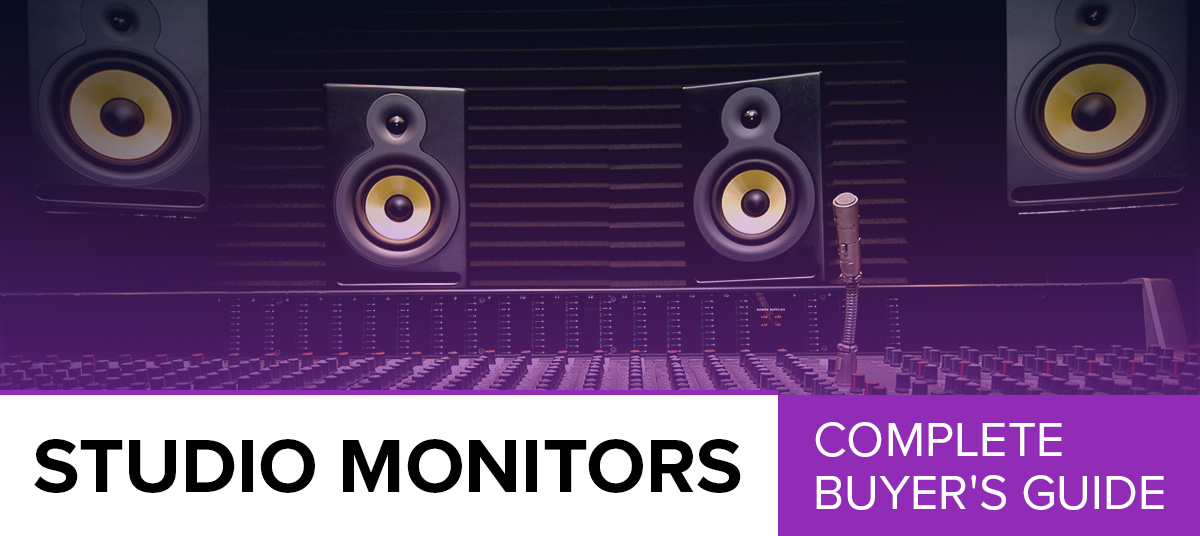
Last Updated: October-17-2018 It was all change at the top of our main monitors chart, as we removed a few of the older models and replaced them with some new popular monitors. These inclusions comprised three higher-end models in the Neumann KH 120 A, the PreSonus Sceptre S8 and the Yamaha HS8. A more affordable model from KRK – the RP8G3-NA – also arrived, as did a cool compact monitoring set, the IK Multimedia iLoud.Making ground in the music industry takes a lot of effort. Sure, you need raw talent, patience, enthusiasm and a good ear for detail, but you equally need a range of specialized tools to give you a clear view of your mixes from all angles. Of all the gear found in an average studio, studio monitors are undoubtedly one of the most important pieces. In this article we are going to highlight ten of the best monitors on the market in all price ranges, before taking a closer look at monitors and how to get the best out of them. Let’s get started!
Top 10 Studio Monitor Speakers
What are Monitor Speakers?
Before we take a look at how to buy and how to get the best out of your monitors, it’s probably worth defining what exactly monitoring speakers are. It can be a little confusing, especially to complete beginners, as a studio monitor can look like your average bookshelf speaker – however, their purpose is completely different. So, what are they? Let’s begin by looking at making music. Creating good music is only half the battle. Making good music sound good on every system out there is the real test of a great producer! This means achieving the same results on a home Hi-Fi system as a car stereo, as consumer headphones, and as a massive nightclub. Why is this an issue? Ultimately it all comes down to speaker bias and how they were set up from the factory. For example, some speakers and headphones are really bass heavy. In affordable systems, manufacturers sometimes like to loosen up the low-end because it gives the sound a bit more girth, while possibly masking deficiencies in other portions of the frequency range. At the other end of the spectrum we have more expensive systems, where each speaker may contain several drivers, each tasked with handling a specific band of the frequency range. Creating a piece of music that will sound good on both budget and premium speakers is not as easy as it seems. This is where studio monitors come in. Look at them as a testing rig. These speakers will be as neutral as possible with a transparency of sound that allows a producer to really hear the nuances of their music, and know exactly how it will sound on a variety of different setups and what needs fixing.Transparency and Monitoring
These days, ‘transparency’ has become a bit of an abstract term. It gets tossed around without much explanation. An easy way to explain transparency is to use a simple graph. Your vertical axis is measured in decibels (in other words, volume), while the horizontal axis represents the frequency range. To your left will be the lowest frequency that the speaker can reproduce, while the right side is the highest. These types of graphs are made by placing a microphone next to the speaker and recording the output. If we take a standard set of bookshelf speakers and perform this test, chances are you’ll see a positive curve in the lower frequencies, which then dips as it reaches the mids, before spiking again in the trebles. This tells you which frequencies are louder, and which ones are not pushed as hard. With studio monitors, all you want to see is a flat line from the lowest possible frequency to the highest one. That type of flat output is what we consider the definition of transparency, as every portion of the frequency range is represented equally. In practice, having the entire frequency range reproduced at roughly the same volume allows you to notice even the smallest flaws in your mix – such as an instrument that is too loud or too quiet. This is why some beginners, who have never experienced monitoring speakers and such transparency, may conclude that their brand-new monitors simply don’t sound right. However, being so transparent and neutral, proper monitoring speakers often come across as a little bland. Rest assured, this is exactly what they are supposed to sound like – there is no thumping bass, nor those screaming highs. Getting used to this flatness takes some time, however, you will truly appreciate this transparency the moment you finish your first mix and it sounds great wherever it is played.Power and Power Management
Many people associate power measured in watts with volume. However, power impacts so many other things, which are far more important. Before we get onto this area, let’s take a look at how power is supplied to the speakers. There are two types to note – active and passive units. Active speakers are those that have a built-in amplifier, meaning that they require no external amplification. Passive speakers are the complete opposite. In order to run these, you will have to purchase a standalone amp. In 2018, active monitors are more or less the norm. These speakers will vary in terms of how many power amps are included per cabinet. Generally speaking, cheaper models will only have a single amp to push both transducers. As you begin moving into the higher end of the market, you will find dedicated amplifiers for each transducer. Having a pair of dedicated amps will result in more definition and transparency in the sound, as each amp only has to drive a single transducer. Of course, you can also find high-end tri-amp speakers, with individual amps powering high, mid and low frequencies. Returning to power – if you have a small home studio, 20 watts of power will get you more than enough volume. However, going with a more powerful set is still beneficial as the extra wattage will give you more headroom. This translates to how far you can push the speaker before it starts distorting – having more power will result in less distortion and a clearer, more detailed sound.How to Correctly Position Studio Monitor
One of the most overlooked aspects when working with speakers – especially monitoring speakers – is proper positioning. Unlike standard bookshelf speakers, more often than not studio monitors are ‘nearfield’. This means that they produce the best results when the user is just a meter or two away from the speaker (i.e. ‘near’). The further away you are, the less definition you’ll have. So, when you are sitting this close to the speaker, you will need to have them set up correctly for optimal sound. Thankfully, positioning the speakers is not that complicated if you follow a set of simple rules:- Firstly, ensure the speakers are level with your head and aimed at you. Imagine that a laser beam is shooting from the center of those drivers. You want the beam from each cabinet to be pointed at your head.
- Next, ensure that the two speakers and your head form an equidistant triangle. This will allow the sound waves from each speaker to reach you without conflict. If you set the speakers too close or too far apart, the sound will become skewed.
- Another thing to keep in mind when positioning the speakers is the distance from the walls. Most pairs feature bass reflex ports, which are either on the back panel or the front side of the speaker. The issue with bass frequencies is that they propagate in all directions. With rear-firing bass ports, having them too close to a wall will result in those low frequencies bouncing off the wall and back at you. It is therefore recommended that you keep at least 2ft between a reflex port and the wall.