Small Hands and Guitars - What Are Your Options?
If you are a guitar player, you have probably seen some guitarists who simply dominate the fretboard. It appears that there is no limit to which chords they can fret, or what kind of a jump they can make. Although guitar is one of those instruments that isn't all that exclusive in terms of who can play it, some people are gifted more than others.
If there is one physical trait that comes in handy when you want to be proficient on guitar, it's large hands and long fingers. Guitar players who have such hands are simply better predisposed to achieve higher levels of skill faster and easier. So what about people with small hands? What kind of issues are they facing, and what solutions are there to help them overcome those issues? This is the topic we are going to dwell into today and try to explain the situation.
 Guitar players with small hands are facing a number of difficulties other guitar players don't have to worry about. Gripping certain chords is hard, especially in fast chord progressions, while some transitions are nearly impossible to make. So, what are your options if you fall within this group of guitar players?
The first thing you can do is search for guitars that have a scaled down fretboard. This a bit of a radical solution, but it's also the one that is most comfortable in the long run. If you're interested in what these guitars look like, and what you can expect from one, check out our list of recommended acoustic and electric guitars for small hands.
Guitar players with small hands are facing a number of difficulties other guitar players don't have to worry about. Gripping certain chords is hard, especially in fast chord progressions, while some transitions are nearly impossible to make. So, what are your options if you fall within this group of guitar players?
The first thing you can do is search for guitars that have a scaled down fretboard. This a bit of a radical solution, but it's also the one that is most comfortable in the long run. If you're interested in what these guitars look like, and what you can expect from one, check out our list of recommended acoustic and electric guitars for small hands.
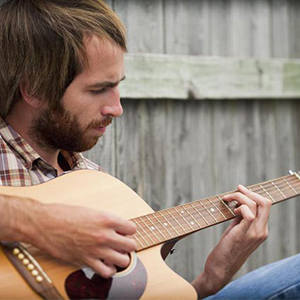 One of the most influential ways of getting some flexibility in your hands is to do various exercises. The best one is to practice fretting distant notes with your index finger and your pinky finger. Try to reach as far as you can, some three or four frets at least.
Working on that stretch is going to take some time, but ultimately you will gain additional flexibility in your fretting hand that is going to be extremely useful later on. A good way to get yourself started on this is to grip power chords with your index finger and your pinky. It's not the textbook technique, but it will help you get used to being comfortable gripping wider distances on the fretboard.
One of the most influential ways of getting some flexibility in your hands is to do various exercises. The best one is to practice fretting distant notes with your index finger and your pinky finger. Try to reach as far as you can, some three or four frets at least.
Working on that stretch is going to take some time, but ultimately you will gain additional flexibility in your fretting hand that is going to be extremely useful later on. A good way to get yourself started on this is to grip power chords with your index finger and your pinky. It's not the textbook technique, but it will help you get used to being comfortable gripping wider distances on the fretboard.
 If you are seriously having trouble playing certain shapes on the lower notes of your guitar's fretboard, you might want to consider changing the position. As you probably know, you can play a single scale on different portions of the neck.
Going further up the neck will reduce the distance your fingers have to cover since the frets are going to be much more narrow. This doesn't necessarily mean that you have to change the octave of the bar you want to play, but rather use alternative fretting to achieve the same results. Again, this might not be the textbook way of playing guitar, but you have to make due with what you got.
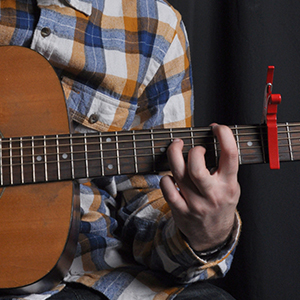
On a similar note, using tools such as capos can also yield positive results. Sure, you are essentially shortening the scale of a guitar and changing the root pitch, however eliminating those tricky first few frets can turn a song from impossible to comfortable in terms of playing. Using a capo probably won't work all the time and in every single situation, but it's a great option to have available should you need it.
If you are seriously having trouble playing certain shapes on the lower notes of your guitar's fretboard, you might want to consider changing the position. As you probably know, you can play a single scale on different portions of the neck.
Going further up the neck will reduce the distance your fingers have to cover since the frets are going to be much more narrow. This doesn't necessarily mean that you have to change the octave of the bar you want to play, but rather use alternative fretting to achieve the same results. Again, this might not be the textbook way of playing guitar, but you have to make due with what you got.
On a similar note, using tools such as capos can also yield positive results. Sure, you are essentially shortening the scale of a guitar and changing the root pitch, however eliminating those tricky first few frets can turn a song from impossible to comfortable in terms of playing. Using a capo probably won't work all the time and in every single situation, but it's a great option to have available should you need it.
Small Hands And Guitars - What Are Your Options?
Guitar players with small hands are facing a number of difficulties other guitar players don't have to worry about. Gripping certain chords is hard, especially in fast chord progressions, while some transitions are nearly impossible to make. So, what are your options if you fall within this group of guitar players?
The first thing you can do is search for guitars that have a scaled down fretboard. This a bit of a radical solution, but it's also the one that is most comfortable in the long run. If you're interested in what these guitars look like, and what you can expect from one, check out our list of recommended acoustic and electric guitars for small hands.
Exercises
One of the most influential ways of getting some flexibility in your hands is to do various exercises. The best one is to practice fretting distant notes with your index finger and your pinky finger. Try to reach as far as you can, some three or four frets at least.
Working on that stretch is going to take some time, but ultimately you will gain additional flexibility in your fretting hand that is going to be extremely useful later on. A good way to get yourself started on this is to grip power chords with your index finger and your pinky. It's not the textbook technique, but it will help you get used to being comfortable gripping wider distances on the fretboard.
Using Alternative Tools And Techniques
If you are seriously having trouble playing certain shapes on the lower notes of your guitar's fretboard, you might want to consider changing the position. As you probably know, you can play a single scale on different portions of the neck.
Going further up the neck will reduce the distance your fingers have to cover since the frets are going to be much more narrow. This doesn't necessarily mean that you have to change the octave of the bar you want to play, but rather use alternative fretting to achieve the same results. Again, this might not be the textbook way of playing guitar, but you have to make due with what you got.
On a similar note, using tools such as capos can also yield positive results. Sure, you are essentially shortening the scale of a guitar and changing the root pitch, however eliminating those tricky first few frets can turn a song from impossible to comfortable in terms of playing. Using a capo probably won't work all the time and in every single situation, but it's a great option to have available should you need it.