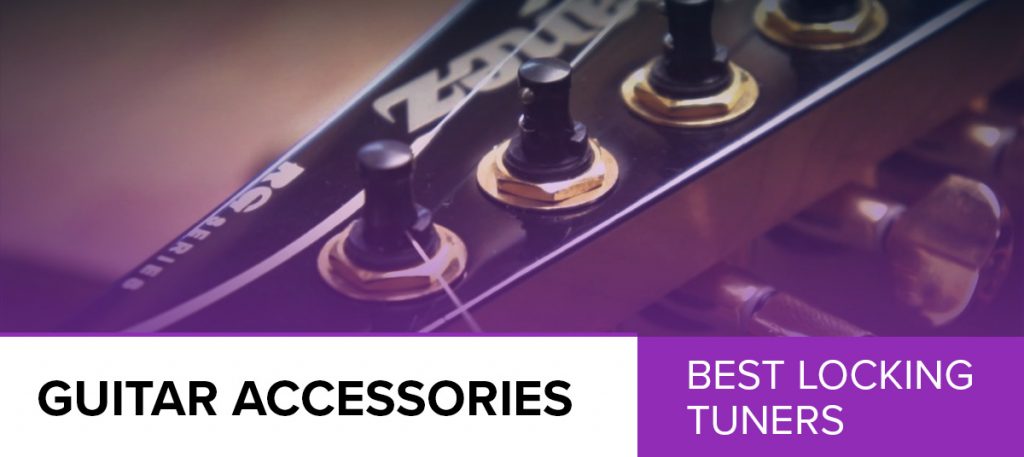
Locking tuners are one of the latest hot accessories to hit the mainstream. So much so that some guitar manufacturers ship their guitars with locking tuners installed. However, there is a lot of misinformation going on about this type of tuning machines. Today we are going to explain what locking tuners will and won't do, as well as show you some of the best locking tuners on the market. By the time we are done, you should have all the necessary information about tuners of this type. With that said, lets get started.
Locking Tuners The Truth And Misconceptions
Guitars, much like all string instruments are prone to falling out of tune. This is especially true if you are aggressive in your playing style. Frequently bending strings, using tremolos and similar things will undoubtedly have a negative impact on your tuning. This is where most users turn to locking tuners. The idea is that locking tuners prevent such risks and offer rock solid key retention. Here's the thing. Locking tuners aren't immune to dropping out of tune. As a matter of fact, half of the time it's not your tuners that are at fault. The bridge, nut and other components can have an impact on your key as well.
With that said, locking tuners definitely reduce the risk of your guitar falling out of tune. The main difference between standard tuners and locking ones is the fact that you don't have to wind the string around the tuner numerous times. Instead, you just push it through the peg and lock it using the provided mechanism.Those couple of wraps are what can cause tuning issues. Since they are no longer required, your tuning stability is becomes much better.
Finding The Right Set Of Tuners For Your Guitar
When you go out looking for an aftermarket set of locking tuners, there are several things you need to look for. For starters, there is the size of the tuner itself. Some models are designed for specific guitars and will be a perfect fit, but some may require you to widen the hole in your headstock. If you can get a drop in set of tuners, you are golden. However, making those adjustments to your instrument shouldn't stop you either. It's a pretty normal thing. Then we have the orientation of the tuners. There are staggered sets for guitars where tuners are all on the same side of the headstock, but there are 3/3 sets. These are meant for headstock designs such as the one Les Paul features.
Drilling Holes
Lets get back to customizing your headstock for a moment. This can be a very scary process for those who aren't familiar with basic woodworking. Fact of the matter is that different brands use different gauge tuners. You simply won't find an aftermarket set that fits every single guitar out there. Because of this, drilling out your headstock to make room for a new set of tuners tends to be a very normal thing. You can easily learn how to do this with any of the numerous guides available online. However, if you are not comfortable handling this type of job, it is probably better to take the guitar down to a shop and have them do it. Since installing aftermarket tuners isa common process, you won't have to pay too much to get it done. Now that we know a bit about locking tuning machines, it's time to check out some cool models.
Best Locking Tuners For Fender Stratocasters
When it comes to Strats, or most Fenders for that matter, it is best to stick to inhouse tuners. Fender offers a variety of different sets, most of which are great at keeping the guitar in tune. The one we have picked for this short rundown is pretty basic but ultimately perfect for Strats.
Best Tuners For PRS SE
PRS offers a great middle ground between Fender and Gibson. This is most likely why they haveskyrocketed in popularity these past decade. If you are looking for aftermarket locking tuning machines for PRS SE, you have a couple of options. We are going to name a few of the most popular ones.
Best General Purpose Locking Tuners
Those who don't mind altering their headstocks a little to fit aftermarket tuners, can broaden their options quite a bit. In this segment we will show you some of the most popular choices which work.
Conclusion
Aftermarket locking tuners are an inexpensive performance booster. However, sometimes they are actually necessary. Any guitar, no matter how much you paid for it, is only as good as its ability to retain a key. If it can't meet that rudimentary requirement, it won't be of much use. It is common knowledge that a simple set of locking tuning machines can turn a starter guitar from a practice axe to something that can easily be used on stage. Changing tuners is inexpensive, easy and simply logical in most cases.
Models we have shown you today are by far some of the best. With that said, there are many more awesome sets made by these brands and many other. If you are thinking about swapping tuners, the best way to start your search is to look for sets that require no drilling or other types of adjustments. Depending on the model of your guitar, this may be tricky. Either way, you can always drill some holes and be done with it.