Published on this page in the GuitarFella archive — what our editors chose at the time, not a lab test.
Last Updated: November 19, 2019
In our latest article refresh, we removed a few dated audio interfaces and replaced them with two excellent entry-level models worthy of your time – the robust Mackie Onyx Artist 1X2 and the all-round quality Tascam US-1X2.
Not so long ago, recording music at home was difficult for many, and out of reach for most. However, with the advancement of modern technology – in particular devices like audio interfaces – we finally have a way to easily record audio at home without having to break the bank.
In today’s article we are taking a look at some of the
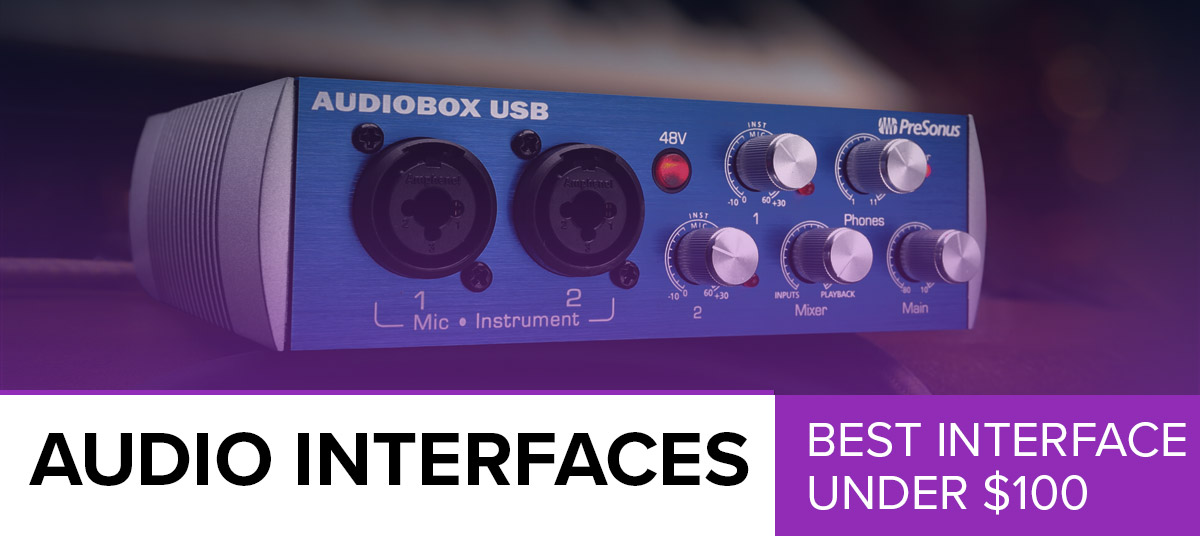
best audio interfaces that come in at under $100. As you’re about to find out, recording guitars and vocals at home is now not only possible but also very affordable.
After the chart we will take a closer look at buying one of these devices, but let’s begin with a rundown of our top picks.
7 Budget Best Audio Interfaces Under $100:
What to Expect From a $100 Audio Interface?
One of the biggest and most consistent misconceptions about audio interfaces is that you have to spend a lot of money to get a good one. However – as out chart may have hinted – this is simply not true.
With audio interfaces, there is a very well-defined base performance. The models we have featured in the chart meet (and sometimes exceed) that performance. Of course, we’d be lying if we said a
$500 audio interface doesn’t tend to deliver more versatility and better features that something in the budget range, but the chances are that the core performance is more or less the same.
At the end of the day, all affordable audio interfaces are designed primarily to deliver good sound on a budget. Most will offer both a microphone preamp and an instrument channel, as well as decent output options and controls, but you can’t expect much more than the basics.
How Does it Connect?
In 2018, there are four ways of connecting an audio interface to your computer (increasing in speed): USB, Firewire, Thunderbolt and PCIE. When it comes to connectivity, a smaller budget is naturally going to be a limiting factor.
With this in mind, it should be no surprise that most entry-level interfaces use a standard USB 2.0 setup. Faster connections, such as Firewire and Thunderbolt, are more or less reserved for
pro-grade audio interfaces.
Aside from being guaranteed connectivity with your computer (because all computers have USB inputs), the bandwidth USB 2.0 allows for is capable of pushing the 24-Bit/192kHz rate, so for most home users and beginners, this connection will be fast enough. When your needs start calling for much more than that, it is time to look at upgrading your audio interface.
What About Compatibility?
Another thing to look out for is whether the audio interface is compatible with both your operating system – PC or Mac – and your DAW (Digital Audio Workstation) software. Thankfully, more often than not, even a budget audio interface will be compatible with both Windows and Apple products, and pretty much all DAWs, including SONAR, Pro Tools, Ableton, Cubase, and Studio One.
However, you should read reviews or visit the manufacturer’s website to determine if it will be compatible with your DAW. If you don’t have a DAW yet buy your audio interface first, then find a
suitable DAW that will work with it.
Can I Record Vocals with a Budget Audio Interface?
In short – yes! In most cases, every half-decent interface comes with an XLR connection and a solid mic preamp that will allow you to record vocals. However, it is up to you to determine what quality you need.
While a budget interface will allow you record, if you are looking for a crystal clear and completely transparent sound, you might have to spend a bit more. However, for general use and beginners, a budget interface will do a good job.
How to Choose a Budget Interface?
Because the budget range is just as diverse as the rest of the audio interface market, one of the most important factors you need to consider is your main use for the interface.
For example, some interfaces only offer a few inputs, such as one microphone line and one instrument line – for individuals this will be ample, but for others (such as those in a band) it won’t be enough. Some budget interfaces offer two or even four inputs, sometimes cutting corners in other areas to accommodate these, however you may want to increase your budget to find something more suitable.
Also consider the form factor and size of the device. Will you be keeping it in your home or studio? If so, you can opt for a slightly bigger or heavier device and it won’t make much difference. However, if you are always working on the fly, a small, lightweight and rugged device may be better for throwing into your gig bag. In this budget price range, you won’t find any rack interfaces, but it’s still worth being aware of the dimensions and weight before you buy anything.
Finally, as we have touched upon, the higher the price you pay for an audio interface, the better the sound quality. If you are recording for fun, to experiment or to make tracks for demos and so on, then chances are a budget interface will fit your needs. If you are trying to make a piece of music for a wider audience, you may want to opt for a more expensive interface to ensure you are getting the best quality.
The Final Word
An audio interface is a core piece of hardware for every modern home recording studio. It’s hard to imagine creating music without one.
The affordable interfaces we have shown you today are by far some of the best you can buy on a budget and will do the job for any home studio. Look for one that meets your needs and then read some reviews about it. Don’t be afraid to peer into the
sub-$200 range, just in case you find something more suitable.
Good luck with your search for the perfect budget audio interface!