Published on this page in the GuitarFella archive — what our editors chose at the time, not a lab test.
Last Updated: November-12-2018
We decided to give this important article a bit of a revamp as we approached winter, so we updated the article content as well as the chart itself. We removed the slightly dated PreSonus AudioBox1818 VSL, instead adding the great-value Behringer U-PHORIA UMC1820 in its place.
In 2018, shopping for a
good audio interface has never been easier – whether you are browsing the
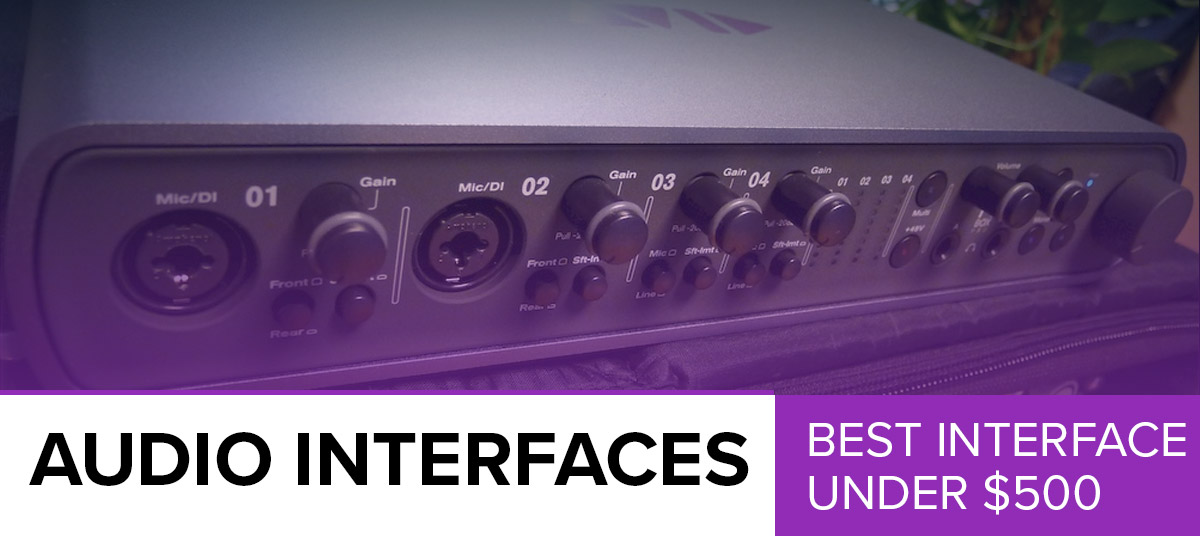
budget range or the premium market. Today we are looking at those units that sit somewhere in between the two – audio interfaces that can be yours for around $500 or less.
In the chart below, we have highlighted a handful of the best models in this price range – all well worth your time if you are looking for a quality interface for a professional home studio.
In addition, we have compiled a handy buyer’s guide just below to help you choose the right unit for your requirements. Before that, let’s dive straight into the chart!
Top 7 Audio Interfaces Under $500
What Can You Expect from a $500 Interface?
So, you have found a few extra dollars to make the jump from an
audio interface under $200 to something in this sub-$500 range? Excellent! You have basically doubled your options and will be able to find an audio interface that will become a very useful partner in your recording adventures.
In this section there are plenty of upgrades that you just don’t find in the entry-level categories. To make this article easier to follow we will divide these features into several segments, comprising I/O options, designs, connectivity, internal hardware and software.
Upgraded I/O Options
Let’s start with probably the most obvious upgrade that $500 audio interfaces enjoy – better input and output options, which can meet the demands of busier studios and more complicated recording scenarios. Forget the one, two or four inputs of the budget categories, here you will usually find eight or more inputs as standard, with some units reaching up to around 18 inputs.
It’s worth noting that these aren’t all analog inputs. For example, in an 18-input device, you’ll usually find eight standard XLR/TRS combined ports as well as 10 digital inputs such as SPDIF ports and ADAT links. Whether or not you actually need the digital I/O cluster is completely down to your requirements, but the fact that they are there makes this category very attractive.
Flexible Design
Looking at the actual design or form factor of the interface, you will see differences in this range. Up until this price point, the majority of models were designed to be used on a desktop, sitting next to your laptop and taking up relatively little room. However, now we start to see application-specific interfaces – in other words, rack-mounted designs.
These interfaces slot neatly into a rack and easily screw in on the sides. As you will probably be aware if you are shopping in this price range, racks are one of the best ways to organize your audio gear and just about anything that’s not an amp or a mixer can be put in a rack these days. If you have a large studio and you are running racks, buying a rack-friendly audio interface might be the best way to go.
Connectivity
One of the best things about investing a little more into your audio interface is the choice of connectivity. Many budget models usually run on standard USB 2.0 (with average speeds of 480Mbps), which is very acceptable. In fact, many in this $500 still use USB connections with great results.
However, some of the most modern interfaces are really pushing that USB 2.0 standard to its limits. When you are sinking up to $500 into your audio interface, you will be pleased to find a few other connectivity options on offer, including Thunderbolt models. Having a Thunderbolt connection can be the difference between a good interface and a great interface, as it can offer speeds of up to 20 times higher (rated at 10 Gbps per channel).
In practical terms, this translates to a much lower latency, even when you load the signal with all kinds of bandwidth-eating effects. The only downside to using Thunderbolt is that you have to have a matching motherboard. Bear this in mind when making your purchase!
Internal Hardware
Of course, mic preamps and A/D converters are the core of any audio interface. As you can imagine, units in this price range tend to have much better versions of this hardware compared to the budget models.
Many brands will use their flagship preamps, much like Roland with their Octa-Capture tech. They have taken the hardware straight from their most popular mixers and integrated it into the interface. If you are serious about recording music and you need the clearest recordings and the best quality possible, having a top-notch preamp matters.
Software
When it comes to recording audio, the software you use is half the experience. Most of the models on our list come with at least one DAW, as well as a whole array of additional plugins and other goodies.
This can be real high-end software, which can help turn your recordings into something very special. It’s unlikely to be a deal-breaker (especially if you already own your own DAW), but be aware that the software and extras on offer in this range really hits the spot.
The Final Word
The best thing about audio interfaces is how they tend to scale naturally. Those in the affordable entry-level range are awesome for smaller home studios, and – as you work your way up – you start to see devices suitable for professional use. The models we have listed above are a great example of pro-grade audio interfaces.
With both desktop and rack-mounted units, USB and Thunderbolt devices, we hope our chart has given you a good idea of what’s out there in this range as well as a bit of inspiration. Whatever you eventually go for we hope it gives you years of trusty recording pleasure!